For most people, evenings tend to follow a pattern. You finish work, get home, and look for something to help you shake off the tired, stressed feelings of the day. There’s a stretch of time in front of you that’s supposed to be your time, but it doesn’t always feel that way. It feels open-ended. Unstructured.
At some point, the thought shows up: I’ll just have one. Take the edge off.
It’s a sneaky feeling. Familiar, and automatic. A drink gives the night a shape. It softens the edges of the day and becomes something to settle into, without having to think too much about what comes next. And then the night goes how it usually goes. One drink is never really one drink.
Later, there’s often a quiet awareness of it. Not necessarily regret, just a sense that you’ve been here before. Sitting on the other end of the evening, thinking once again about how it’s not really working, but still finding it hard to imagine doing something else instead.
If you’ve been trying to figure out what to do instead of drinking at night, this point of the night is usually where the question appears. Not in a big decision to quit. Just a small, repeated moment you’re getting tired of living.
Why This Pattern Happens
What’s easy to miss is that this pattern isn’t random. Nightly drinking doesn’t usually come from a lack of discipline. It builds its way into your routine because it works — at least in the short term.
Evenings are a time of transition. You move from structured time into unstructured time, and that gap can feel jarring and uncomfortable. Drinking fills it quickly. It turns something undefined into something predictable. If there’s one thing we are wired to crave, it’s predictability.
Over time, that relief becomes routine. Your brain learns that this is how the night starts. Not because it’s the best option, but because it’s the most familiar. Frictionless. And by the end of the day, that familiarity tends to win.
That’s why the drinking after work habit can feel so automatic. It isn’t just a decision, it’s something your brain has learned to repeat. So if you’re trying to interrupt it, the goal isn’t to overhaul your entire evening. It’s to give that moment a new direction to turn to. Not something perfect, just something different.
What To Do Instead of Drinking at Night
One of the simplest ways to start is to stop the pattern right at its start. Instead of structuring your whole night, focus on the first few minutes. The very beginning of that transitional time, when you’d normally pour a drink, is the part that matters most. Instead of planning everything, you just decide: what happens right then?
It could be something as simple as making a specific non-alcoholic drink, stepping outside for a few minutes, or taking a quick shower. The point isn’t the activity itself, it’s cutting off the pattern right from the start.
From there, it helps to have one small anchor for the evening. Not a full routine. Just a starting point. Something like sitting down to write a journal page, prepping something simple to eat, or watching one episode of something without drinking. You’re not trying to be productive. You’re giving the night a predetermined direction.
Small environmental shifts can also help more than you would expect. If drinking usually happens in one dedicated place, at the same time, with the same setup, your brain starts to expect it. Changing something about that routine – where you sit, the background sounds, or what you’re holding – can be enough to interrupt that automated expectation.
And it’s important to keep the bar low.
A lot of alternatives fail because they’re too ambitious. You don’t need a full workout or a perfect routine. In fact, it’s better to give yourself some space for flexibility. You need something you’ll actually do when you’re tired, even for just 10 minutes. Keep it repeatable. Keep it simple.
Why It’s Hard to Change
Even with all of that, you might still find yourself defaulting toward the same loop some nights. Not because the ideas don’t work, but because they still require you to decide what to do in the moment. And that’s the hardest part.
By the end of the day, your decision-making capacity is worn down. So even good alternatives get overridden by habit and convenience. That’s where a lot of people get stuck trying to stop nightly drinking. They keep searching for the right replacement, and when it isn’t readily available, drinking is the easiest option. The real issue isn’t the activity. It’s the lack of structure around it.
What actually makes evenings easier is having a guideline to follow. Not something rigid or overwhelming, just something that removes the need to make new decisions every night. Instead of asking yourself what to do in place of drinking, it becomes simple. You already know what comes next.
A Simple Structure That Actually Helps
A solid plan can look like this:
You start your evening the same way each day, even if it’s small. You have a basic response prepared and ready for when cravings show up, so you’re not negotiating with yourself in the moment. You keep track of something simple, just enough to notice patterns, and you end the night intentionally instead of letting it drift.
That’s it. Nothing complicated. Just planned and repeatable.
Some people figure this out over time on their own. Others do it better when everything they need is laid out in front of them, especially on days when they’re running on fumes and don’t want to think through it all from the beginning. That’s where having some structure can help.
Not a strict program, but something to follow when your brain is done for the day and the need for relief is high. A basic system — something with a clear starting point, a plan for responding to cravings, and a way to track progress — can make actually following through a lot easier.
If you want something like that already put together and ready to use, I’ve created a simple sobriety journal kit built around those exact pieces, using my own personal experience with quitting drinking. It’s designed to give you something to follow so you’re not figuring it out from scratch every night.
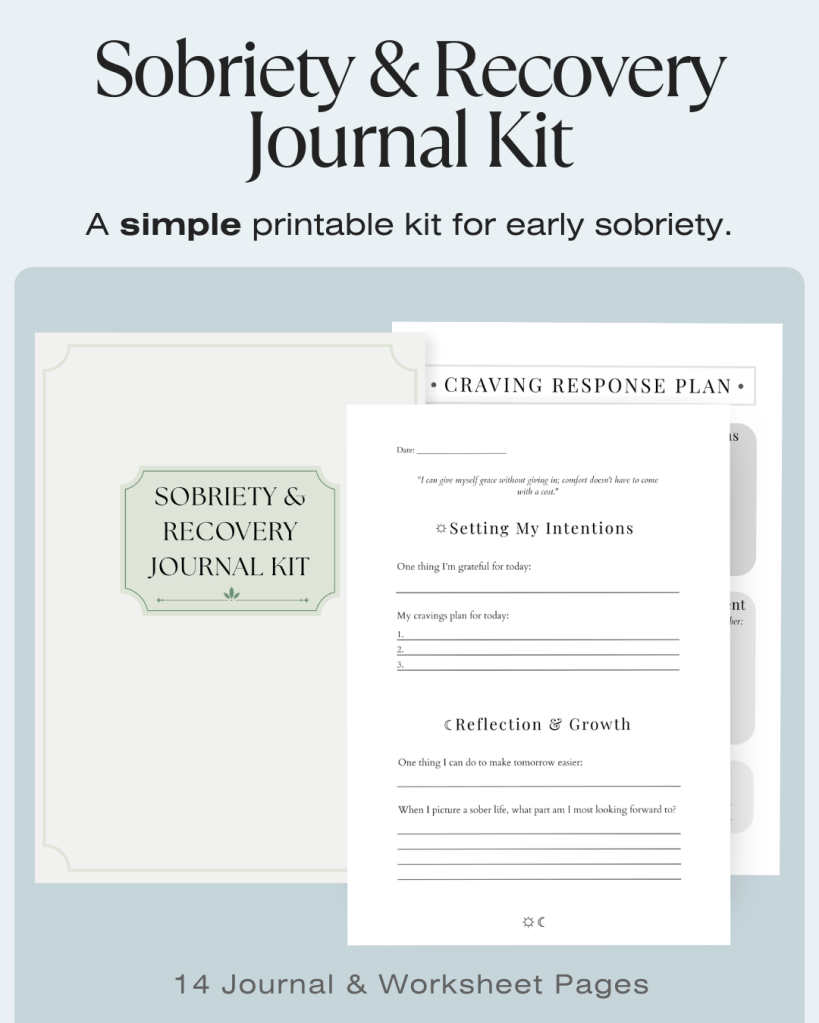
You don’t have to use anything structured. But when you’re trying to change a drinking after work habit, that kind of structure offers more than motivation can provide on its own. It gives you a pattern you can actually follow when the moment hits.
If you’ve been noticing this pattern, that already counts for something. You don’t have to solve everything at once. You don’t have to make a big decision tonight. Most of the time, change starts smaller than that. It starts with interrupting the moment once. Trying something slightly different. And repeating that, even imperfectly.
Over time, evenings stop feeling like something you fall into. They start to feel a little more deliberate. Not perfect. Just different enough to move forward, and start feeling like your evenings belong to you again.
 Steady Next Step
Leave a comment