Night cravings have a different weight to them.
During the day, you might be busy enough to keep moving. There are errands, work, noise, people, tasks, distractions…. Even if the thought of drinking shows up, it might not have enough space to fully take over. But at night, everything gets quieter.
The day is mostly done. Your body is tired. Your mind has less to grab onto. Maybe you’re sitting on the couch, lying in bed, cleaning up the kitchen, scrolling your phone, or standing in the same place you used to stand when drinking was part of your routine. Nothing dramatic has to happen. The craving can show up in a very ordinary moment. And because the rest of the world feels still, the urge can feel louder than it did earlier.
It might start as a thought: I could just have one. Or, Tonight feels hard. Or, I don’t want to keep doing this right now.
Sometimes it feels like a physical pull, other times it feels emotional. It can come through as restlessness, irritation, sadness, boredom, loneliness, or a strange kind of emptiness that you can’t quite name. That’s part of what makes night cravings difficult. They do not always arrive clearly labeled as “a craving.” Sometimes they arrive as simply wanting relief.
By the end of the day, your brain has already made hundreds of small decisions. You have gotten through whatever the day asked of you. You may have dealt with people, stress, responsibilities, disappointment, exhaustion, or just the basic effort of trying to stay sober when part of you still wants the old escape route. So when night comes, it makes sense that your mind reaches for what used to be familiar.
That does not mean you are weak. It does not mean you are failing. It usually means your brain is tired, your routine is changing, and the old pattern is trying to reassert itself because it knows that path well.
Why Night Cravings Feel So Hard
This is why willpower can feel so unreliable at night.
Willpower sounds useful in theory. It makes sobriety seem like a matter of deciding firmly enough and then holding that decision perfectly. But in the actual moment of a craving, especially at night, the problem is not always that you lack discipline. The problem is that your brain is tired and looking for the easiest familiar option. If drinking used to be how you ended the day, shifted your mood, quieted your thoughts, celebrated, numbed out, or gave yourself something to look forward to, then nighttime may still carry that association for a while.
Your brain may not be thinking about the full consequences. It may not be thinking about tomorrow morning, or the reasons you decided to stop. It may simply be reaching for the quickest known relief. That is why trying to argue with the craving for the whole night can feel impossible. The more you tell yourself, I can never drink again, or I have to get through every night like this, the heavier the moment becomes. The shift is much smaller than that.
You Do Not Have to Solve the Whole Night
You only have to get through the next 10 to 20 minutes.
That might sound too simple, but it matters. A craving can make the future feel huge. It can turn one uncomfortable moment into a story about the rest of your life. It can make you feel like you need to prove, right now, that you are capable of staying sober forever. You don’t.
In the moment, your job is not to become a completely different person. Your job is to create a little bit of space between the urge and the action. Sometimes that starts with delay. Not a dramatic, permanent vow. Just a pause. You might tell yourself, I’m not deciding anything for the next 15 minutes. That’s different from saying, I must never want this again. It takes some pressure off. It gives your brain a smaller task.
You can still feel the craving during those 15-ish minutes. The goal is not to instantly feel calm. It’s to not move in the direction of drinking while the wave is at its strongest.
Small Pattern Breaks Matter
Changing your environment can help more than it seems like it will. Not in a big, impressive way, but enough to interrupt the pattern. If you’re sitting in the place where you usually drink, move to another room. If you’re in bed spiraling, get up and wash your face. If you’re pacing around the kitchen, step outside for a minute or stand somewhere with different lighting. If your phone is making the craving worse, put it across the room and do something with your hands.
These are not magic fixes. They are interruptions to the pattern. At night, the craving often wants you to stay inside the exact setting where the old habit makes sense. Same room. Same time. Same feeling. Same thought loop. A small change can remind your brain that this moment is not automatic, even if it feels that way.
It also helps to choose something repeatable, not something that requires a lot of motivation. A shower. A cup of tea. Brushing your teeth. Putting on comfortable clothes. Turning on a familiar show. Taking the trash out. Eating something simple. Writing one sentence about what you are feeling. Sitting somewhere else until the intensity drops. The point is just to give yourself a next step that requires less thinking.
The Hardest Part Is Deciding What to Do While You’re Already Struggling
Because that is one of the hardest parts of cravings: trying to figure out what to do while you are already in the middle of it. When the urge is strong, your mind may not be very creative. It may not want to remember every reason you stopped drinking. It wants relief, and it wants the fastest familiar option.
That is why having something decided ahead of time can be so helpful. Not because a plan removes the craving; It usually doesn’t. But it can remove the extra burden of having to think clearly while your brain is tired and pulling you toward an old habit.
This Is Why Structure Helps
A craving response plan gives you something to follow before the urge gets louder. Not a complicated recovery program or list of rules. Just a simple structure for the moments where your brain feels tired, emotional, restless, or pulled back toward old habits.
Sometimes the hardest part of a craving is not knowing what to do first. Your thoughts start racing, your emotions get louder, and suddenly even simple decisions feel harder than they should. That is where having a response already laid out can help.
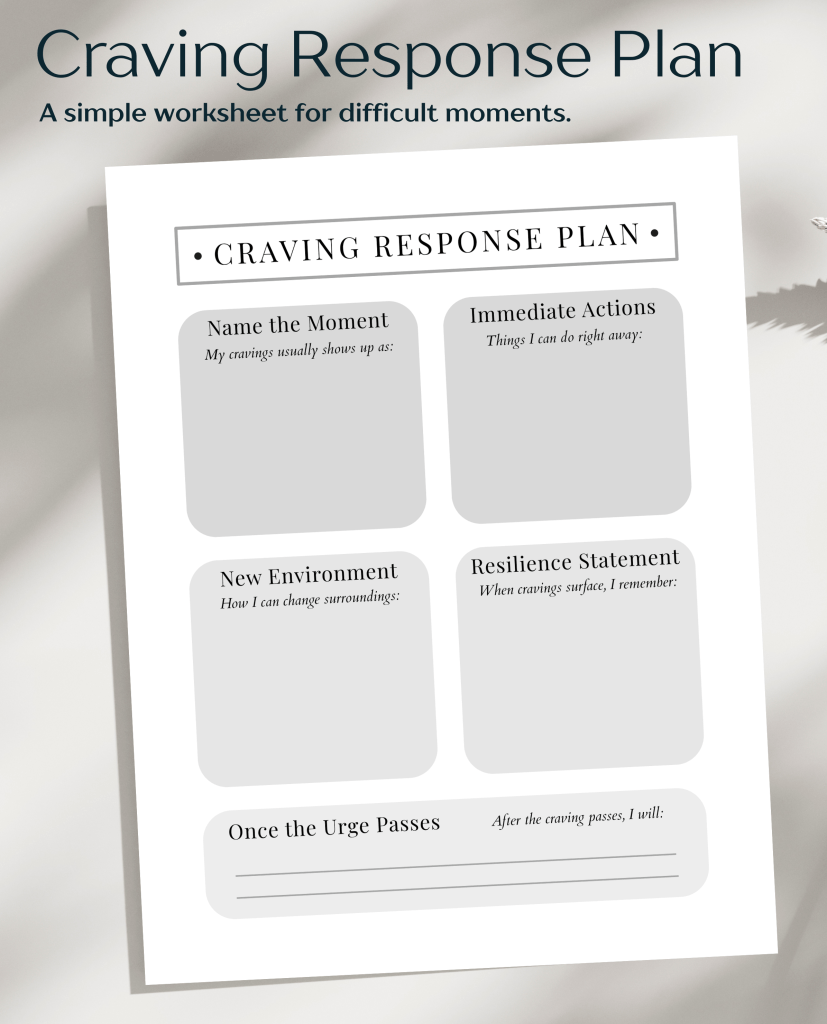
A simple plan can help you:
- recognize what kind of moment you are in
- choose an immediate action before the craving escalates
- interrupt the environment or routine connected to drinking
- remind yourself why staying sober matters to you
- decide what to do once the urge starts to pass
This Craving Response Plan is for exactly these kinds of nighttime moments. It’s designed to be something you can fill out ahead of time and keep nearby so you do not have to rely entirely on memory, motivation, or willpower when cravings hit.
You do not have to handle every night at once, or prove anything about the rest of your life tonight.
You only have to get through this one moment without turning it into a drink. And then, when the next moment comes, you do the same thing again.
 Steady Next Step
Leave a comment