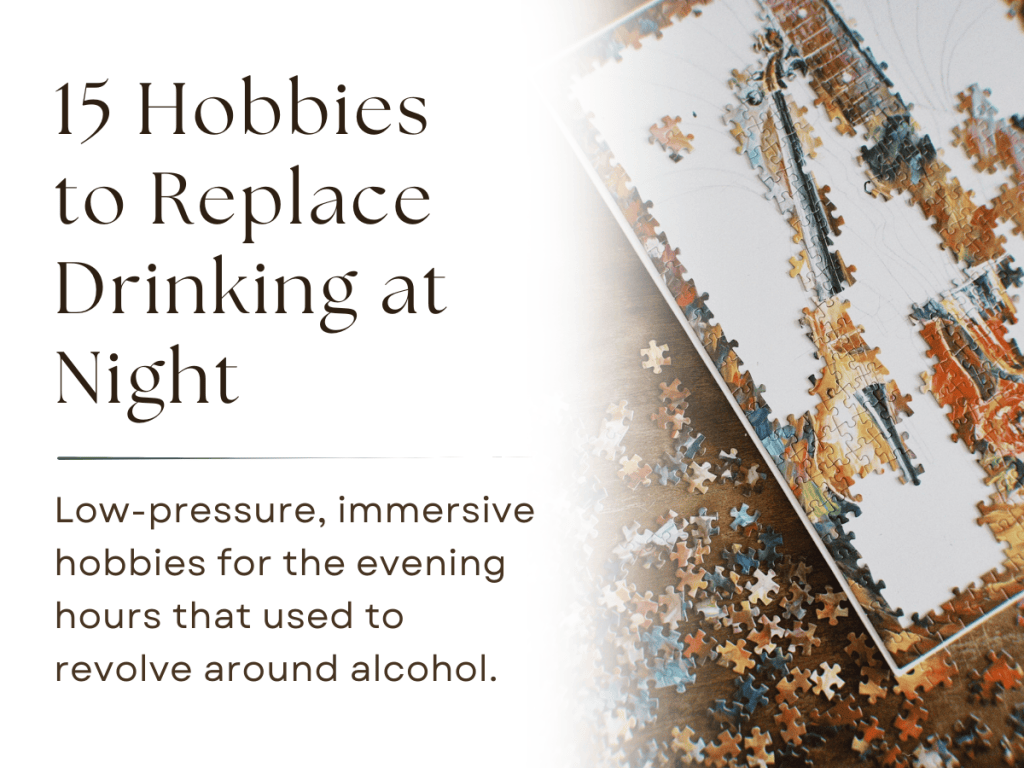
When you stop drinking, the empty stretch of newly available time can be difficult to manage. You might finish dinner and realize there is nowhere for the night to go. You watch something, scroll for a while, wander into the kitchen, check the time, and somehow only twenty minutes have passed. If drinking used to fill a large part of your evenings, sobriety can make time feel unusually visible.
There are reasons those hours can feel particularly uncomfortable in early recovery. Why Evenings Feel So Hard in Early Sobriety goes more deeply into that pattern, but one part of it is simply habit: your brain became accustomed to a familiar sequence, and now the sequence has a hole in it.
Finding hobbies to replace drinking can help fill some of that space, but not because you suddenly need to become a fascinating, productive person with six new interests. For now, a hobby can have a much smaller job. It can give you something to do between dinner and bed. It can occupy your hands when you feel restless. It can make an hour pass without you checking the clock twelve times. Some evenings, that is plenty.
This list is about finding activities you can return to repeatedly until sober evenings begin to feel a little less vacant.
What Makes a Good Hobby in Early Sobriety?
A hobby can sound appealing in theory and still be completely wrong for the stage of sobriety you are in. Learning pottery might be interesting, but it requires leaving the house, finding a class, paying for it, and showing up at a specific time. Crochet can be relaxing once you know what you are doing, but your first evening may involve forty-five minutes of trying to understand why your yarn keeps turning into a knot.
That does not make either one a bad hobby. It just means there are times when a lower barrier to entry is useful. The hobbies on this list were chosen because most of them can be started at home, without much preparation. They give you enough structure to hold your attention without demanding that you be particularly talented, energetic, or emotionally insightful. They also work well with other forms of comfort. You can put on a familiar album, listen to an audiobook, catch up on a podcast, or have a comfort show playing in the background.
Most importantly, you can be bad at them. Nothing terrible happens if your origami bird looks strange, you color outside a line, abandon a puzzle halfway through, or realize your lettering does not resemble the examples online. A hobby in early sobriety does not need to produce anything useful. It mainly needs to be pleasant or absorbing enough that you are willing to come back to it tomorrow night.
Hands-Busy, Brain-Absorbing Hobbies
There are evenings when sitting quietly with your thoughts is not especially appealing. You may feel restless without knowing what you want. You might keep picking up your phone, walking into the kitchen, or thinking about drinking simply because your brain knows drinking as the usual next activity.
Hands-on hobbies can work well during those nights because they give you two forms of occupation at once: something physical to do and something small to concentrate on. All five of these can also be paired easily with music, podcasts, or audiobooks if you need a little more stimulation.
1. Jigsaw Puzzles
Jigsaw puzzles are unusually good at making forty minutes disappear. There’s always a small task directly in front of you: find the corner pieces, separate the blue pieces, finish one patch of sky, locate the irritating piece that obviously belongs somewhere in the window frame. That kind of problem-solving can be helpful when your brain has been spending too much time circling larger questions.
Puzzles also give you visible evidence that you did something with the evening. A half-finished puzzle on the table is concrete. Last night there were two hundred loose pieces. Tonight there are fewer. If you haven’t done a puzzle in years, skip the impressive 1,500-piece landscape at first. A 300 or 500-piece puzzle is much more likely to give you that satisfying feeling of progress before it starts feeling like another obligation.
2. Paint-by-Number Kits
A blank canvas can feel less like an invitation and more like a demand. Paint-by-number removes most of that problem. You still get the experience of mixing colors, filling sections, watching an image slowly appear, and making something with your hands. But, importantly, don’t have to invent the image yourself.
There is enough concentration involved to occupy your brain without requiring much decision-making. And although the finished painting can be satisfying, it does not need to be beautiful enough to hang on a wall. The useful part can simply be having a project sitting on the table that you can return to when the evening starts dragging.
3. Adult Coloring Books
Coloring is useful because it asks so little of you to begin. You don’t need to learn anything. You don’t need a large workspace or a complicated supply list. A book and a pack of colored pencils are enough. That makes it a particularly good option for low-energy nights.
There may be evenings when starting a project sounds exhausting but doing absolutely nothing leaves too much room for restlessness. Coloring sits comfortably in the middle. You can work on one page while listening to an album, watching something familiar, or letting a podcast run in the background.
If elaborate adult coloring books feel more stressful than relaxing, choose simpler ones. You do not need microscopic botanical patterns with six hundred leaves. Large shapes and easy designs work just as well.
4. Origami or Paper Folding
Origami gives your brain a sequence. Fold this corner here. Turn the paper over. Open this section. Fold along the crease.
When your thoughts keep returning to drinking, embarrassment, regret, tomorrow, last year, or whatever else your brain has decided to replay, following a sequence can interrupt the loop for a while. It’s also one of the easiest hobbies to experiment with before spending much money. You can learn basic folds using ordinary printer paper and free tutorials. If you end up enjoying the process, you can always buy nicer paper later.
5. Diamond Painting
Diamond painting is a good match for anyone who finds tiny repetitive tasks strangely satisfying. You work section by section, placing small resin pieces onto a coded adhesive canvas. There is very little creative decision-making involved, but there is enough precision to keep your attention from wandering too far. It can become surprisingly immersive.
Gradually, a picture starts appearing beneath your hands. For someone who feels physically restless in the evening, that repetitive movement can be especially useful. Your hands remain occupied, your eyes have somewhere to focus, and the progress is obvious. If you are the sort of person who enjoys organizing small objects, completing tiny sections, checking things off, or watching a picture slowly fill in, this may be one of the better sober hobbies to try.
Cozy Creation Hobbies
Some hobbies occupy time. Others start giving that time a little personality. After drinking has been part of your routine for a long time, you can discover that you are not entirely sure what you like anymore. Not in some dramatic identity-crisis sense: You may just have gotten used to spending your free time in roughly the same way.
Creative hobbies can give you small opportunities to notice your own preferences again. What colors do you keep choosing? What songs are you saving? What photos do you like enough to print? What kinds of things do you want around you? You don’t have to turn any of this into deep personal exploration. Sometimes it’s nice simply to make something because you like looking at it.
6. Making Collage Pages
Collage is ideal if you want to make something but don’t want the pressure of drawing well or knowing what you’re trying to say. You can use old magazines, packaging, stickers, scrapbook paper, photographs, ticket stubs, paint swatches, or whatever else happens to look interesting.
You can make a page around a color, a season, a mood, a place you would like to visit, or absolutely nothing in particular. You might find yourself choosing images that feel angry, strange, soft, nostalgic, chaotic, funny, or hopeful without needing to explain why. Or, maybe you just cut out pictures because you like them.
7. Scrapbooking or Memory Keeping
“Scrapbooking” can sound like a fairly elaborate hobby involving decorative scissors, themed paper collections, and photographs arranged with professional precision. It doesn’t have to look anything like that. Memory keeping can be as simple as buying a notebook and occasionally taping something into it.
A picture from your phone. A movie ticket. A screenshot you printed because it made you laugh. A label from a tea you unexpectedly loved. A picture of your dog asleep in an absurd position.
This can be particularly meaningful in early sobriety because life may feel temporarily narrowed around the fact that you are not drinking. Recovery can become the main event in your head even while ordinary life continues around it. Saving little pieces of that ordinary life gives you proof that other things are happening too.
8. Hand Lettering or Calligraphy
Hand lettering has a naturally slow pace. You make one stroke, then another. You practice the same letter several times. You start noticing spacing, pressure, angles, and the shape of individual words. That attention to tiny details can make it a pleasant evening activity, especially if your brain has been moving too quickly all day.
It is also easy to make the hobby as structured or unstructured as you want. You might copy song lyrics, write favorite lines from books, letter ridiculous phrases that make you laugh, or practice the alphabet while listening to something in the background.
9. Making Playlists for Different Moods
Drinking often becomes part of an emotional transition. You pour something because work is over. Because you are irritated. Because you want the evening to feel different from the afternoon. Because you are lonely. Because you want energy. Because you want to slow down.
When alcohol has been doing that job for a while, it helps to have other cues that tell your brain the mood is changing. You could make a calm evening playlist, an angry cleaning playlist, a nostalgic-but-not-depressing playlist, or one specifically for the hour when cravings usually show up.
The process of building the playlist is a hobby in itself. You end up listening through old songs, rediscovering things you forgot about, and noticing which music changes your mood without much effort. Then the playlist becomes something you can actually use.
10. Photography or Artwork Boards
A mood board does not have to be a collection of pristine interiors and aspirational internet images. It can be much more personal than that. Make a physical or digital board from your own photographs, drawings, sketches, screenshots, designs, color combinations, typography, outfits, crafts, or other creative pieces you have saved over time.
You could create one around a season, a visual style you like, things you want to make, or images that just seem to belong together. If you take photographs, start collecting your favorites instead of letting them disappear into a camera roll containing eight thousand pictures. If you draw or make things occasionally, those can make the board too.
Over time, the board becomes less about creating a perfect aesthetic and more about noticing your own taste. There may be more of it there than you realized.
Screen-Light but Still Immersive Hobbies
There is nothing inherently virtuous about avoiding screens. If you spend the evening playing a game you love, working through a digital puzzle, or following a dance video, you have not failed at having a “real” hobby. The more useful distinction is between choosing something and falling into it automatically.
Endless scrolling can leave you feeling as if two hours vanished without actually giving you much rest or enjoyment. A more intentional screen-based activity gives your attention somewhere specific to go.
11. Cozy Gaming
The right game can be excellent company during a sober evening. Cozy farming games, decorating games, life simulators, story-driven games, and choice-based RPGs give you a small world to step into for a while. That matters when real life currently feels repetitive or gray.
Gaming can also replace some of the anticipation that drinking used to create. You may start looking forward to getting home because you want to finish building something, reach the next part of the story, or see what happens after a decision you made yesterday.
Pay attention to how a game leaves you feeling, though. Look for something that is engaging enough to absorb you without making your nervous system feel as though it just entered combat.
12. Sudoku, Crosswords, or Logic Puzzles
If crafts make you impatient but you still need your brain occupied, puzzles are an easy alternative. Sudoku, crosswords, word searches, nonograms, logic grids, and similar games give you a defined problem with an answer. For a while, your brain gets to care about whether seven belongs in that square instead of whatever it was worrying about ten minutes earlier.
Keep a puzzle book somewhere obvious. Put it next to the couch, on the coffee table, or near the place where you usually sit at night. When a craving or boredom spiral begins, the activity with the lowest number of steps between you and starting it has an advantage.
13. YouTube Dance-Workout Channels
Sometimes the problem isn’t that your brain needs another activity. Your body is restless. You may feel irritable, twitchy, uncomfortable sitting down, or full of energy with nowhere to put it. A dance workout gives that energy somewhere to go without requiring you to leave the house.
You can follow a full thirty-minute routine if you want, but there is no requirement to turn this into a fitness program. Put on one dance video. Do one song. Stop afterward if you feel better. Music plus movement can also change the atmosphere of a room very quickly, which makes this useful during the part of the evening when you would normally use alcohol to shift your mood.
14. Reading a Long Series
Reading sounds wonderfully calm in theory. In practice, early sobriety can make opening a book surprisingly difficult. You read the same paragraph three times. You reach the bottom of a page and realize you have no idea what happened. A book you would normally enjoy feels like homework. If that happens, it doesn’t necessarily mean you can’t concentrate anymore. Sometimes your attention just needs a little time to settle.
A highly entertaining series can help because once you care about the characters and story, starting the next reading session takes less effort. You are not repeatedly trying to enter a completely new world. Fantasy, romance, mysteries, thrillers, cozy mysteries, adventure series, historical fiction — anything is fair game.
A four-hundred-page fantasy novel you devour is much more useful here than a critically acclaimed book you resent every time you see it on the nightstand. Give yourself a few pages before deciding your attention span can’t handle reading. Sometimes the first ten minutes are the hardest part, and then the story takes over.
15. Food and Drink Recipe Collecting
Before quitting drinking, you may have spent more time than you realized thinking about what you were going to drink. What was in the house. What you would have with dinner. What you would pick up on the way home. That mental space does not always disappear immediately when you stop.
Recipe collecting can redirect some of that planning instinct toward things that are actually enjoyable to have around. Create a Pinterest board, notebook, digital folder, or simple collection of recipes you genuinely want to try. It might include mocktails, sparkling drinks, iced teas, cozy drinks, easy dinners, snacks, desserts, interesting breakfasts, or things you can make on Friday night when you want the evening to feel slightly special.
Over time, though, you may start developing new little rituals without deliberately trying to manufacture them. A certain tea becomes your night drink. Friday becomes homemade pizza night. You keep ingredients around for a mocktail you find you particularly like. The evening begins acquiring new things to anticipate.
How to Choose the Right Hobby to Start With
A list of fifteen hobbies can quickly turn into fifteen things you think you should now be doing. Ignore most of them. Look through the list and choose the one that sounds easiest to begin tonight, or at least this week.
If there’s already a half-finished puzzle in your closet, start there. If you own colored pencils, print a coloring page. If spending money is not practical right now, try origami with printer paper, make a playlist, find a free logic puzzle, or borrow an ebook from your library.
Avoid buying a complete new personality at the craft store. You don’t yet know whether you actually like diamond painting, calligraphy, scrapbooking, or paint-by-number. A cheap beginner kit is enough to find out whether you want to keep going. Then give the activity a fair twenty minutes.
The first five may feel awkward because your brain is accustomed to doing something else during that time. You may feel restless. You may think, This is stupid. I could be drinking right now. Keep going for a little while before you decide.
It can also help to pair the hobby with something else you already enjoy: an audiobook, a favorite playlist, tea, sparkling water, a podcast, or a comfort show you have seen before. That combination can slowly become its own evening ritual.
If none of the hobbies feel right, that is useful information too. Try another one. You are not choosing your lifelong passion. You’re trying to find a few reliable things to replace the time drinking used to take from you.
The Hobby Does Not Have to Fix Everything
There will probably still be evenings when nothing sounds interesting and you resent the fact that you have to find something else to do at all. That doesn’t make hobbies useless. They can give an evening a different shape.
Instead of drinking from seven until eleven, perhaps you work on a puzzle for forty minutes, make something to eat, watch a show, take a shower, and go to bed. It may not feel profound. It may simply be a night you got through without drinking. Enough nights like that begin creating a different routine.
And if you’re wondering whether sober evenings eventually stop feeling so strange, Does Sobriety Get Easier? looks more closely at how recovery can change over time.
At first, a hobby may just be something you do with your hands while the urge passes. Months later, you might realize there is a puzzle on your table, a game you are halfway through, a stack of books beside your bed, playlists you made for specific moods, photographs you actually printed, or a recipe you now make every Sunday.
None of those things needs to symbolize recovery. They are simply pieces of a life that contains more than drinking.
Quick Recap: 15 Hobbies to Replace Drinking at Night
- Jigsaw puzzles
- Paint-by-number kits
- Adult coloring books
- Origami or paper folding
- Diamond painting
- Making collage pages
- Scrapbooking or memory keeping
- Hand lettering or calligraphy
- Making playlists for different moods
- Photography or artwork boards
- Cozy gaming
- Sudoku, crosswords, or logic puzzles
- YouTube dance-workout channels
- Reading a long series
- Food and drink recipe collecting
Start with the one that feels easiest to set up, not the one that sounds most impressive.


Leave a comment