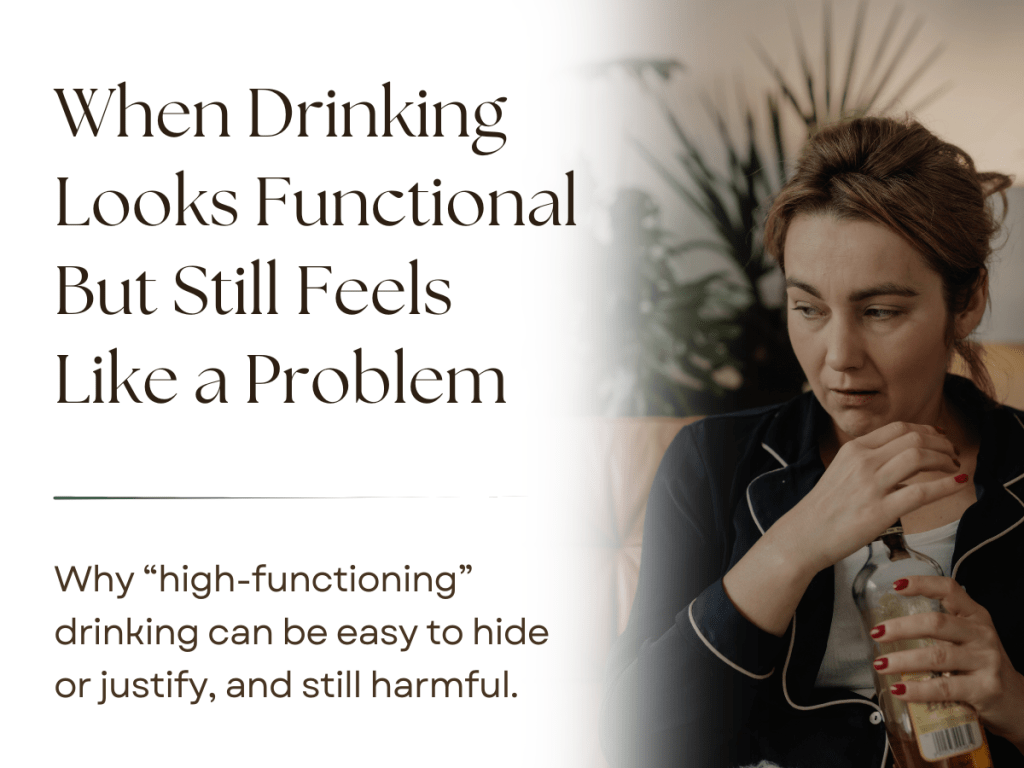
There is a confusing place many people find themselves in before they ever say the words “I have a drinking problem.” Nothing obvious has fallen apart. You go to work, pay your bills, answer texts, show up for family events, keep the house mostly together, and doing enough of what is expected of you that nobody is especially worried. From the outside, your life may look normal. Maybe even responsible. But privately, you know alcohol is taking up more space than it should.
The problem isn’t always that everything has collapsed. Sometimes the problem is that you are working very hard to keep it from collapsing, and alcohol has quietly become part of how you are holding yourself together.
What “High-Functioning” Drinking Can Look Like
When people imagine an alcohol problem, they often picture something obvious: missed work, public consequences, visible chaos, damaged relationships, or a life that has become impossible to hide. That can happen. But it is not the only way alcohol problems look.
High-functioning drinking can be quieter. It can blend into daily life, especially in a culture where drinking is often treated as normal stress relief. A glass of wine after work, a few drinks to unwind, a weekend binge, a “deserved” reward after a hard day. These things can be easy to explain away because so many people talk about alcohol this way.
You may be drinking heavily and still getting up in the morning. Tired, anxious, irritable, or foggy, but still able to push through. You may be performing well enough that nobody sees what it costs you. For some people, alcohol becomes the main transition between the demands of the day and the privacy of the evening. Work ends, responsibilities slow down, and drinking becomes the thing that signals, “Now I can relax.” Over time, that can turn into less of a choice and more of a requirement.
You might also find yourself hiding the amount you drink, even if you are not hiding the fact that you drink at all. You might pour stronger drinks than people realize. Replace bottles before anyone notices. Drink before or after social plans so your public drinking looks moderate. Maybe you downplay the frequency because saying the real number out loud would make it feel harder to dismiss.
Another common part of high-functioning drinking is comparison. You may look at someone who drinks more openly, has more visible consequences, or seems less in control and think, “At least I’m not that bad.” That comparison can feel reassuring for a moment. But it doesn’t always answer the more important question: Is alcohol creating a problem in your life? Not compared to someone else’s life. Not compared to the worst version of what addiction can look like. Your life.
You may also notice anxiety around alcohol itself. Feeling nervous about running out, irritated when plans interfere with drinking, or tense when you try to cut back.Those reactions are worth paying attention to, even if you are still showing up everywhere you are supposed to.
Why It Is So Easy to Rationalize
One reason high-functioning drinking is so hard to question is because the rationalizations often sound reasonable.
“I still have a job.”
“I’m not drinking in the morning.”
“Other people drink more than me.”
“I only drink at night.”
“I’m not hurting anyone”
These thoughts can become a kind of private defense system. They help you move the concern away from the center of your mind so you can keep going. And in some ways, they may feel true. But those facts do not automatically mean alcohol is harmless in your life.
Functionality can become evidence you use against your own discomfort. Because nothing looks “bad enough,” you may dismiss the quieter signs: poor sleep, low motivation, rising anxiety, mood swings, less patience, more isolation, more shame, more bargaining, less trust in yourself.
You may keep moving the line for what counts as a real problem. At one point, drinking alone might have seemed concerning. Then it became normal. At one point, drinking every night might have sounded like too much. Then it became your routine. At one point, finishing a bottle, blacking out, hiding empties, or breaking your own limits might have felt like a wake-up call. Then the mind found a way to soften that too. This is not because you are weak or dishonest. It’s because the brain is very good at protecting patterns that feel necessary, especially when those patterns offer relief.
If alcohol has become the thing that helps you relax, numb out, sleep, socialize, avoid feelings, or get through loneliness, then questioning it can feel threatening. Even when part of you wants freedom from it, another part may be afraid of what life will feel like without that escape hatch. So the rationalizations keep doing their job.
The Private Cost of Looking Fine
The hardest part of functional drinking is often the gap between what other people see and what you experience privately. Other people may see someone who is handling life. You may see the mental math that starts in the afternoon. How much is left at home. Whether you need to stop at the store. How early is too early. How much you can drink and still be okay tomorrow. Whether tonight will be different. Whether you really mean it this time. There can be a constant bargaining process that nobody else hears.
And then, when the night goes the same way it usually does, there may be that familiar drop in your stomach. The disappointment. The shame. The quiet frustration of watching yourself cross a line you had set only hours earlier when you told yourself you didn’t need to drink tonight. It can feel especially confusing when you are still functioning. You may be proud that you are keeping your life together, and exhausted by how much effort it takes.
The cost may show up in your evenings first. Hours disappear into drinking, scrolling, numbing, or zoning out. Plans for hobbies, cleaning, reading, creating, moving your body, or simply resting in a way that actually restores you may keep getting pushed aside. Not because you do not care about those things, but because alcohol becomes the center of the night.
Then the cost moves into your mornings. You wake up tired, dry-mouthed, anxious, or disappointed. Maybe you aren’t severely hungover, but you’re not well either. You get through the day, but you feel dulled. Your energy is lower than it should be. Your patience is thinner. Your motivation feels harder to access.
Over time, alcohol can take things that are difficult to explain because they are not always dramatic. It can take away your clarity, your emotional steadiness, or your confidence in your own word. It can take the feeling that your time belongs to you. A drinking problem does not have to be publicly visible to be real. That matters.
Questions to Ask Yourself Honestly
Self-honesty does not have to be harsh. It does not require labeling yourself immediately or deciding what the rest of your life has to look like. Sometimes it starts with asking better questions and letting yourself answer without rushing to explain the answer away.
You may want to sit with these gently, but honestly:
- Do I drink more often or more heavily than I intend to?
- Do I feel protective, defensive, or secretive about my drinking?
- Do I plan parts of my day around alcohol?
- Do I feel anxious, irritated, or deprived when I cannot drink?
- Do I keep moving the line for what would “count” as a problem?
- Is alcohol helping me avoid stress, boredom, loneliness, grief, or anger?
- Do I use alcohol as my main way to relax or feel normal?
- Have I tried to cut back and found it harder than expected?
- Do I feel shame, regret, or disappointment after drinking?
- Would I feel uncomfortable taking a real break from alcohol?
These questions are not a courtroom. They are not here to trap you into a conclusion. They are meant to help you notice what you may already know but have not wanted to fully face. The answers may not be simple. You may think, “Yes, but not always.” Or, “Sometimes, but only when things are stressful.” Or, “It depends.” That is okay. Patterns are still patterns even when they are not present every single day.
The point is not to force yourself into panic. The point is to stop using functionality as the only measure of whether something is hurting you. If alcohol is making your inner life smaller, heavier, or harder to trust, that deserves your attention.
What to Do If This Feels Familiar
If this article feels uncomfortably familiar, it can be tempting to immediately jump into proving or disproving whether your drinking is “bad enough.” You may want a clear answer, a category, a label, or someone else to tell you exactly what it means. But often, the first step is quieter than that.
Be honest with yourself before trying to explain it to anyone else. You do not have to prepare a perfect speech or defend your concern. You can start by admitting, privately, “Something about this does not feel okay anymore.” That kind of honesty can be surprisingly powerful. Not because it fixes everything instantly, but because it interrupts the habit of minimizing your own discomfort.
A trial break from alcohol can also give you information. It does not have to be framed as punishment or a dramatic life declaration. It can simply be a way to observe what happens when alcohol is removed for a little while.
Do you feel relieved? Restless? Angry? Bored? Anxious? Do cravings show up at certain times? Do evenings suddenly feel empty? Does sleep change? Does your mood shift? Do you find yourself negotiating for exceptions? Those reactions can tell you something.
It may also help to write down what drinking is costing you privately. Not just the obvious things like money or hangovers, though those count too. Write down the subtler costs: the mornings you lose, the plans you abandon, the anxiety you carry, the way you feel about yourself after breaking your own limits. Seeing it on paper can make the pattern harder to blur.
Talking to someone safe can help, if you have that option. That might be a trusted friend, a therapist, a doctor, a recovery community, or a helpline. You do not have to present your drinking in the most extreme possible terms to deserve support. You can simply say, “I’m worried about my relationship with alcohol, and I think I need to talk about it.”
It is also okay to look into support before things get worse. In fact, that is often the kinder time to do it. You do not have to wait until you have lost the job, damaged the relationship, wrecked your health, or scared yourself badly enough to feel justified. Maybe none of those things happen in an obvious way. That doesn’t mean it isn’t hurting you.
Early concern is still concern. Quiet suffering is still suffering. A private problem is still a real problem.
You Do Not Have to Prove It Is Bad Enough
One of the most painful traps in functional drinking is the belief that you need more evidence before you are allowed to change. More consequences. More visible damage. More proof that alcohol is truly a problem. But if alcohol is taking more from you than you want to admit, that matters now. If you feel trapped in a routine that looks normal from the outside but feels wrong on the inside, that is worth listening to.
Recognizing the problem early is not overreacting. It can be a steady, protective choice. It can be the moment you stop measuring your pain against someone else’s worst day and start paying attention to what your own life is asking from you. You may still be holding things together. That does not mean alcohol is not costing you something. It may mean there is still a lot worth protecting.
You do not have to wait until your life falls apart to decide that you want something steadier, quieter, and more honest for yourself. Wanting a different relationship with alcohol is reason enough to begin.
If this article felt familiar and you are not sure where to start, visit the Sobriety Resources page for helplines, meeting finders, and recovery communities.
 Steady Next Step
Leave a comment