The first 90 days of sobriety can feel strangely significant. Not because everything is supposed to be healed by then, early sobriety doesn’t usually work that neatly. But 90 days can give you something your brain may be craving in a time that feels uncertain: a shape. A beginning, a middle, and a point you are moving toward.
When you are first trying to stop drinking, time can feel different. Evenings can stretch out. Weekends can feel too open. A single craving can make ten minutes feel much longer than it is. You may find yourself wondering how many days you have actually made it through, whether this is getting any easier, or whether the effort you are putting in is even visible. That’s where tracking your sobriety can help.
A sobriety tracker doesn’t make early recovery effortless. It does not remove the hard moments, fix the uncomfortable emotions, or guarantee that every day will feel like progress. But it can help you see that something real is happening, even when it feels quiet. It gives you a way to mark the small repeated decisions that are easy to overlook while you are busy surviving them. In the first 90 days, that can matter more than it seems.
Why the First 90 Days Can Feel Psychologically Important
There is nothing magical about 90 days. Reaching that point does not mean you are “done” with early sobriety, and not reaching it yet does not mean you are behind. But as a contained window of time, 90 days can be useful.
When you’re making a major change, especially one that affects your evenings, your emotions, your routines, your sleep, your social life, and your sense of self, it can feel too big to hold all at once. Thinking in terms of “forever” may be emotionally overwhelming, even if a sober life is what you want. Some people find forever motivating. Others find it heavy, abstract, or frightening. Ninety days can feel more reachable.
It’s long enough to matter, but not so open-ended that it becomes impossible to picture. It gives you a stretch of time to move through without needing to solve your entire future today. You can focus on building some stability, learning your patterns, and getting through the moments that used to send you back to drinking.
In those early weeks, your mind may still be adjusting to the absence of alcohol. Your body can still be recalibrating. You may have a lot more emotional space than you are used to, and that space might not feel peaceful at first. Sometimes it feels raw, boring, restless, lonely, or awkward. A 90-day frame can gently say: just keep moving through this part. Not perfectly, or dramatically. Just steadily.
It gives you a way to measure something that otherwise might feel invisible. You’re not simply “trying to stop drinking.” You are moving through a defined stretch of early recovery, one day at a time. That small shift can make the process feel less like floating and more like moving forward with intention.
How Tracking Helps You Stay Accountable to Yourself
A lot of sobriety happens privately. Other people may not see the decision you make at 5:47 p.m. when you’re tired and irritable and the thought of drinking appears. When you choose not to stop at the store, not to pour something, not to send the text, not to create the familiar conditions where drinking becomes easier.
They also probably won’t see the evening you get through by making tea, taking a shower, walking around the block, crying for a little while, going to bed early, or simply sitting with the discomfort until it passes. Early sobriety can involve a lot of effort that does not look impressive from the outside.
That can feel lonely sometimes. It can also make it harder to recognize your own progress. When nobody is watching, and when life does not immediately reward you for every hard choice, it is easy to minimize what you are doing. A tracker gives you a private form of accountability. Not the kind where you’re harshly policing yourself or trying to prove your worth through a streak. More like a quiet check-in with yourself: I did what I said I was trying to do today. I made it through this day sober.
That can be especially helpful if your sobriety is not something you’re talking about with many people. There is nothing wrong with that. Support matters, but not every form of support has to be public. Sometimes accountability begins with having a place where your effort is recorded honestly. A tracker can become a small daily ritual that reminds you that your choices count, even when they are not witnessed. And because it is simple, it does not ask much of you.
What A Sobriety Tracker Can Actually Show You
At first, a sobriety tracker may seem like it only shows one thing: how many days you have not had a drink. That alone can be meaningful. But over time, a tracker can show you more than a number. It can show you momentum.
When you’re inside early sobriety, progress does not always feel like progress. Some days may feel emotionally heavy even though you’re doing something important. You might have a difficult craving on day 17 and think, “Why is this still happening?” Or, you wake up on day 31 feeling flat or restless and wonder whether anything is changing. Then you look at the tracker and see the days behind you.
You see that you have already moved through weekends, bad moods, stressful evenings, boredom, arguments, sleep issues, cravings, and ordinary life without drinking. You may not have felt strong or confident every time. But you were still there, making the next choice. That visible record can help challenge the feeling that you are not getting anywhere.
A tracker can also help you notice patterns: If certain days of the week feel harder, or if evenings after work are the most vulnerable. Maybe the first few sober weekends felt intense, but later ones became slightly more manageable. One of the hardest things about an urge is that it can feel permanent while it is happening. But when you track your days, you start collecting evidence that urges pass. Not always quickly, but they do pass. You can look back and realize: I had a bad night, and I still made it to the next morning.
That kind of evidence matters because early sobriety often requires you to trust a future feeling you can’t access yet. When you’re in the middle of a craving, you may not feel relieved, proud, or clear-headed. A tracker gives you a way to remember that discomfort is not the whole story. It can also show you difficult stretches without making them the entire narrative. That’s important because progress in sobriety is not only made on the days that feel good. Sometimes the most meaningful progress is made on the days that feel completely ordinary, or even discouraging, when you keep your promise to yourself without anyone clapping for it.
How to Use a Tracker Without Turning It Into Pressure
A sobriety tracker should support you. It should not become another way to shame yourself. That distinction is important.
The purpose of a tracker is not to turn your recovery into a performance. It is not there to prove that you are doing sobriety perfectly. It is not there to punish you for having cravings, messy emotions, low motivation, or days where you do the bare minimum. Those things are part of being a person making a difficult change. A tracker is most helpful when it is used with steadiness instead of judgment.
You can mark a day sober even if you felt awful. If you were irritable, unproductive, anxious, bored, or unsure. You can mark a day sober even if all you did was get through the evening without drinking. That still counts. In fact, those days may be some of the most important ones to mark, because they remind you that sobriety does not require a perfect mood. You can have a difficult day and still protect your progress.
Think of the tracker as a record, not a verdict. It is simply showing you what happened. It’s helping you stay connected to your effort, and giving you a visual place to return to when your mind tries to convince you that nothing is changing.
A Simple Tool For Making Progress Visible
If you like having something physical to mark each day, a printable tracker can be a gentle way to make your progress feel more concrete.
This 90-Day Progress Tracker was created for that specific purpose: to give you a simple, low-pressure place to mark your sober days one at a time. It’s not a full planner, a complicated recovery system, or a worksheet that asks you to process everything at once. Just a clear visual space where your effort can become visible.
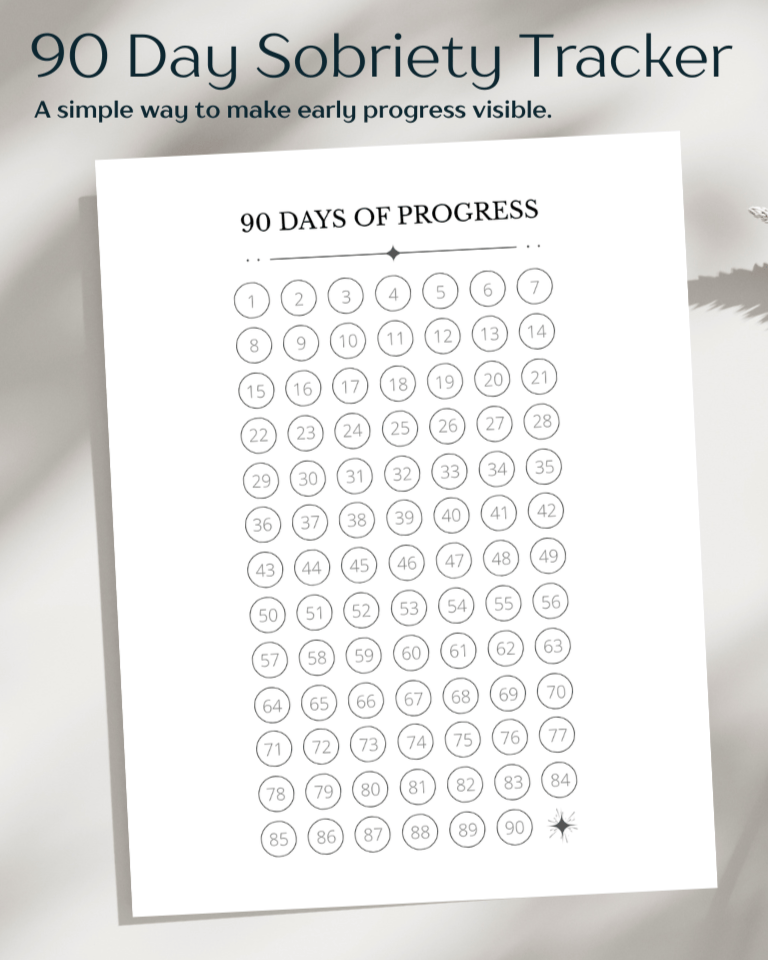
That can be helpful if you are in the first few months of sobriety and want something you can print, keep nearby, and return to at the end of each day. You might place it somewhere private, tuck it into a journal, keep it on your desk, or use it as part of a quiet evening routine. For some people, that small visual reminder can make a real difference. Not because the paper itself changes everything, but because it gives your daily choice a place to land.
Progress Counts, Even When It Feels Quiet
A lot of early sobriety is built in moments that may not look like much from the outside. Choosing not to drink on a normal Tuesday night. Getting through a craving without turning it into a crisis. Going to bed sober even though the evening felt long. Waking up and realizing you do not have to start over today.
These moments are easy to overlook because they’re small. They don’t always come with a dramatic feeling of victory. Sometimes they feel almost silent. But repeated over time, they become the structure of change. Tracking your sobriety can help you notice that. It can help you see that you are not standing still just because the process feels slow. A difficult day does not erase the days before it.
The first 90 days do not have to be perfect to matter. They do not have to be inspiring every day. They can be uneven, uncomfortable, ordinary, and still deeply important. Each day you choose not to drink, you are giving yourself another piece of evidence that you can continue. A tracker simply helps you see those pieces collecting. Quietly, gradually, one day at a time.
 Steady Next Step
Leave a comment